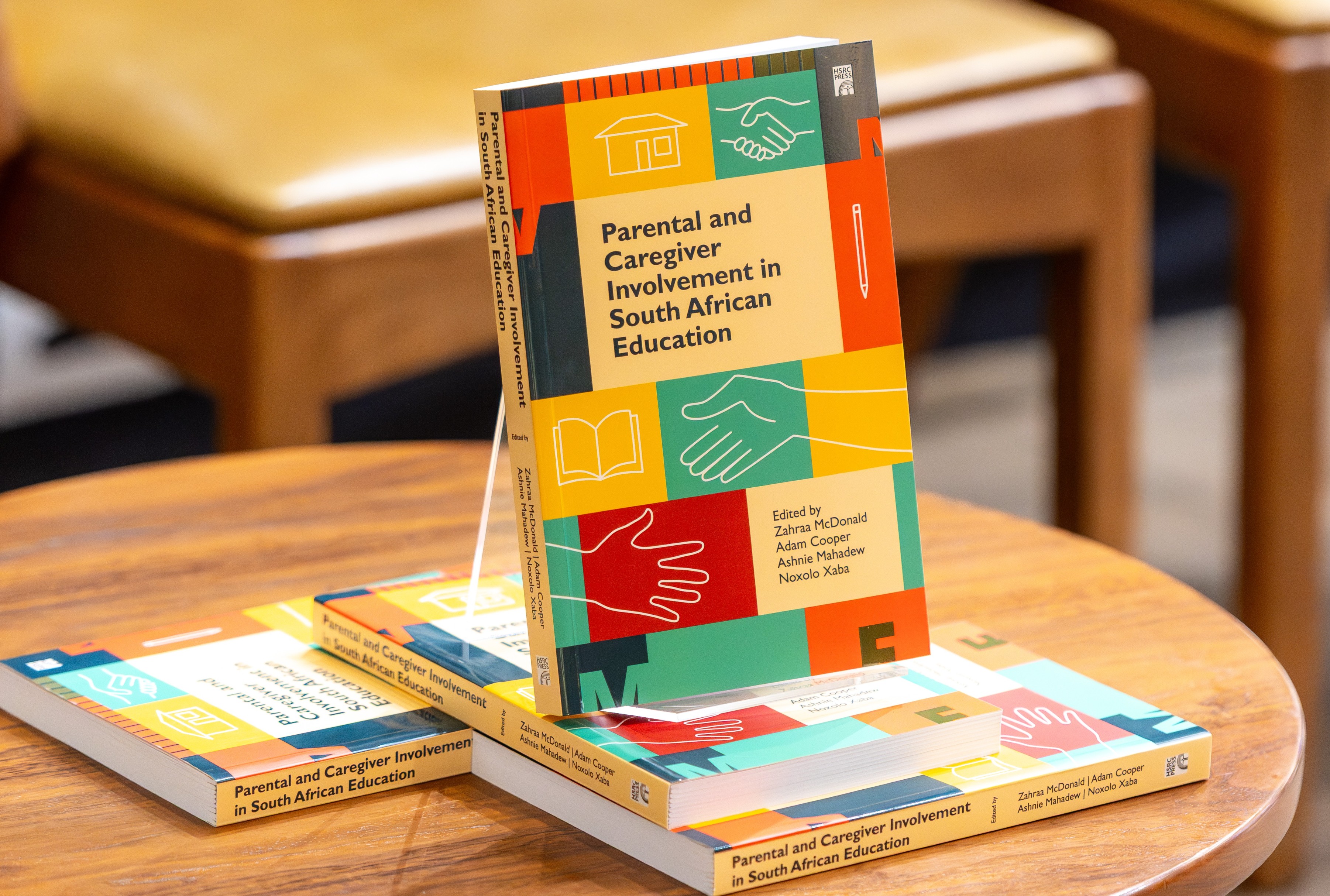
A focus on parent and caregiver involvement in education, particularly in the South African context, emerges from an observation that parental involvement in children’s learning and development, whether at home or at school, plays an important role in improved educational outcomes.
JET and Reos Partners are proud to announce the publication of Parental and Caregiver Involvement in South African Education by the HSRC Press. This book is an edited volume that examines the role of parents and caregivers in shaping learners’ educational journeys across South Africa.
From townships to rural areas to urban centers, South Africa's educational system faces a complex web of varied social and economic realities. The authors of Parental and Caregiver Involvement in South African Education explore both the challenges and the triumphs involved in shaping educational journeys in these diverse contexts.
Powerful research narratives and practical case studies offer authentic insights, as well as actionable strategies, illustrating the essential role of family partnerships and caregivers in creating equitable learning opportunities.
About the Editors
Zahraa McDonald is an associate professor in the Department of Religion Studies at the University of Johannesburg. Adam Cooper is chief research specialist at the Human Science Research Council. Ashnie Mahadew teaches in the School of Education at the University of KwaZulu-Natal. Noxolo Xaba is at the South African College of Applied Psychology.
Contents
Introduction: the Editors
Framing Parental and Caregiver Involvement in Education
Chapter 1: A social justice perspective on parental and caregiver involvement in education policy―Zahraa McDonald, Lungelo Mthembu-Salter, and Noxolo Xaba
Chapter 2: Linking politics, policy, and practice in understanding parent involvement―Bakang Mputle
Chapter 3: Silencing marginalised voices in early childhood development policy ―Lydia-Anne Plaatjies
Contexts of Parental and Caregiver Involvement in Education
Chapter 4: Who are South African caregivers, how do they feel about educational quality, and what is their involvement in schools?―Tarryn de Kock and Adam Cooper
Chapter 5: An inclusive learning environment in early childhood care and education: Enhancing parent and family partnerships―Ashnie Mahadew
Chapter 6: Learning from school principals’ experiences of parental and caregiver involvement at primary schools in low-income communities―Bongani Nhlanhla Mkhize and Kerishka Govender
Chapter 7: What's blame got to do with it? Teacher and parent blame narratives in South African primary schools―Andrew Paterson, Melanie Ehren, and Zaahedah Vally
Chapter 8: Black middle-class parents’ involvement in children’s education: Stories of trauma and hope―Thembeka Myende and Phumlani Myende
Intervening in Parental and Caregiver Involvement in Education
Chapter 9: Deepening our understanding of parental involvement in rural South Africa: Parental support of Grade 2 mathematics homework under COVID-19―Kimberley Porteus, Nicky Roberts, and Nobuntu Mazeka
Chapter 10: Parental involvement programme: A case study across schools and communities in rural South Africa―Craig Gibbs and Kimberleigh Bodley
Chapter 11: aRe Bapaleng: Working with caregivers to create stronger local (in-community) early childhood development ecosystems―Ximena Gonzalez and Khanyisa Mkhabele
Chapter 12: Do caregivers engage with their young children at home, and can teachers influence them to do more? Experiences from the Together in My Education Home Learning Programme―Magali von Blottnitz and Shelley O’Carroll
Chapter 13: Pathways to implementing effective parental involvement programmes in South Africa―Adele Mooi and Abigail Dreyer
Conclusion: Systemic collaboration as an approach to parental involvement―Colleen Magner and Mpinane Mahlatji
Endorsements
“This is an extremely timely contribution. As we grapple with the challenge of radically improving the South African educational system, the contributors to this volume tell us about the structural, affective and practical issues that stand in the way of bringing parents and caregivers properly and fully into the process of education. The chapters are informative and are written with feeling and insight”. — Crain Soudien, Emeritus Professor, University of Cape Town.
"The field of study on school, family, and community partnerships is growing geographically wider and intellectually deeper with this good book of research in South Africa. Each chapter reports important research, with one section on how research results may help improve school programs and practices". — Joyce L. Epstein, Professor of Education, Johns Hopkins University.
JET Exchanges 3/2021: Parental involvement for school improvement: A South African perspective
Author: Craig Gibbs
Published: 2021
This paper gives a brief introduction and background to parental and caregiver involvement in schools, particularly in rural schools in South Africa, through reviewing some of the literature on the subject. It also presents some suggestions on what can be done to improve parental involvement in rural schools. The intention of this paper is to stimulate discussion on this important aspect of school improvement.
Keywords: School Improvement, Bulletin, JET Exchange, Parental Involvement
Improving Literacy and Mathematics in the Primary School: The Country’s Most Important Priority
Author: Schreuder, B
Published: 2008
Keywords: Teacher Education, Parental Involvement, Conference presentations, Teacher, JET Education Services conferences, What Works in School Development
080409 Getting the Talented Poor to Good Schools: The ISASA Mathematics and English Programme
Author: Jane Hofmeyr
Published: 2008
Keywords: Teacher Training, Mathematics, Parental Involvement, JET Education Services conferences, conference paper, What Works in School Development, English, ISASA
Keynote presentation on the occasion of the launch of the RESEP reports: “Binding Constraints in Education” and “Laying Firm Foundations: Getting Reading Right”, Stellenbosch Institute for Advanced Study, Stellenbosch University, 24 May 2016.
National Plan for Post-School Education and Training (NPPSET)
Author: DHET
Published: 2023
The National Plan for Post-School Education and Training (NPPSET) 2021–2030 has been released. The NPPSET sets out a roadmap for implementing the policy vision of the White Paper for Post-School education and Training. The NPPSET sets out key system goals, objectives, outcomes and strategies aimed at achieving an integrated, coordinated, expanded, responsive, cooperative, quality, efficient, successful and articulated post-school education and training (PSET) system over the period 2021/2022 to 2029/2030.
Keywords: DHET, Post School Education, Post School Education and Training, Training, Parental Involvement, NPPSET
JET Bulletin May 2018: Standardized learner assessments in ‘affordable’ independent schools – perspectives from research and practice
Author: JET Education Services
JET Education Services (JET), in collaboration with four school operators and Old Mutual Alternative Investments’ Schools Fund, has been involved in the assessment of educational quality in affordable independent schools using standardised assessments. This work has led to a more developmental use of assessment, with some school operators using detailed analysis of the assessment data to inform their teaching practices.
Theme 10 Research Report: Lessons on How Countries Manage Schooling During and After Disasters
Author: Deva Govender
The study involves a review of literature on how education systems were managed during and after a disaster. Four cases were examined: natural disasters (tsunami and earthquake) in Indonesia and Haiti; civil conflicts in Rwanda, Sierra Leone and Libya and the Vuwani district in Limpopo, South Africa; a health pandemic (Ebola) in West Africa; and the COVID-19 education response globally and in South Africa. All four cases offer valuable insights and lessons for the education sector in South Africa when it comes to strategy, policy, planning and programming of responses for education continuity, preparation to exit the lockdown and for curriculum recovery.
Theme 6 Research Infographic: Ameliorating the Impact of Fake News on High School Learners during COVID-19
Author: Tshepo Motsepe
To investigate South African high school learners’ awareness of fake/false news during the COVID-19 lockdown, types of fake news, and the skills needed for distinguishing between false news and real news.
No Magic Bullets, Just Tracer Bullets: The Role of Learning Resources, Social Advantage, and Education Management in Improving the Performance of South African Schools
Author: Crouch, L
Published: 1998
Keywords: JET Education Services conferences, Parental Involvement, School Quality Research Seminar 2
Equity, Efficiency and the Development of South African Schools
Author: Taylor, N
Published: 2007
Taylor N. (2007). Also published as Chapter 29 IN: International Handbook of School Effectiveness and Improvement . Springer International Handbooks of Education , Vol. 17. Townsend, Tony (Ed.). Dordrecht: Springer.
Who is out of school? Evidence from the Statistics South Africa Community Survey
Author: Fleisch, B
Published: 2012
Fleisch B, Shindler J, Perry H. (2012). Who is out of school? Evidence from the Statistics South Africa Community Survey. International Journal of Educational Development 32 (2012) 529–536. (An earlier version of this paper was presented at the 10th UKFIET International Conference on Education and Development, 15–17 September 2009, New College, Oxford. Funding for the research project was provided by the National Research Foundation and CREATE, University of Sussex. The authors are exclusively responsible for the research presented in this paper).