
10 youth-focused JET initiatives to celebrate Youth Day
National Youth Day is celebrated under the theme: “RESET@50, Our National Commitment to the Future, for Freedom Lives in Every Generation.”. JET Education Services shares 10 youth-focused JET initiatives and publications to celebrate Youth Day. The year 2026 marks the 50th anniversary of the June 16 Soweto and other related uprisings. The Soweto uprising tragedy became a rallying point that inspired a nation and a people to rise up against the apartheid system. The National Youth Policy defines youth as any person between the ages of 14 and 35 years.
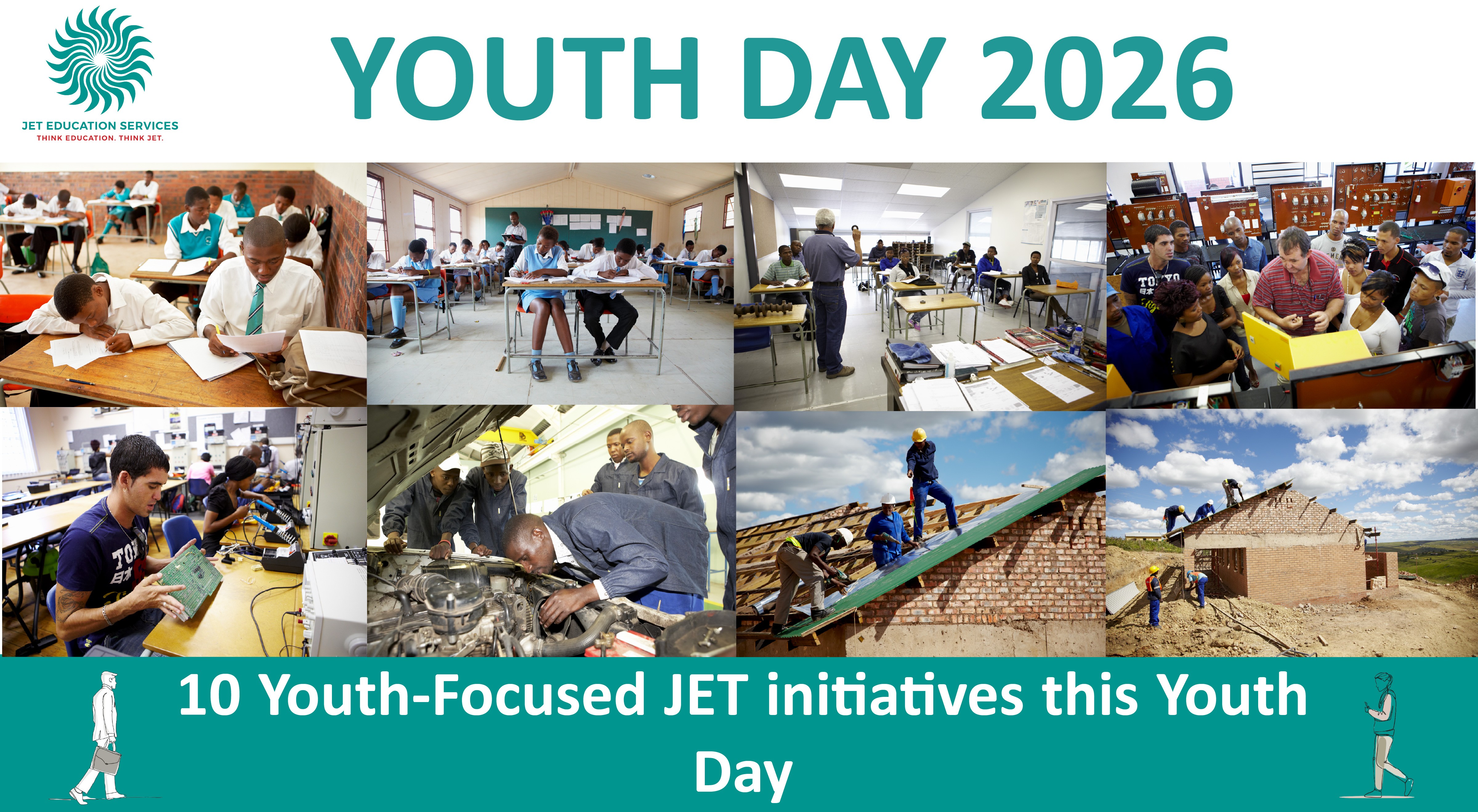
Youth in South Africa continue to be disadvantaged in the labour market with an unemployment rate higher than the national average. According to the Quarterly Labour Force Survey (QLFS) for the first quarter of 2026, the unemployment rate was 60,9% for those aged 15-24 and 40,6% for those aged 25-34 years, while the current official national rate stands at 32,7%.
Here are some of the youth-focused JET initiatives and publications:
1. JETstreaming Capacity Building Programme: Building youth capacity, especially in research, has for long been a JET imperative, we have been supporting internships for youth for at least ten years. In June 2019, the JETStreaming Project, our own internship programme which had been in the planning stage for some time, came to fruition. The JETStreaming capacity building programme, aimed at building social justice change agents focusing on education research through a combination of experiential workplace involvement and collaborative training processes. Through the programme, ten young graduate professionals gained workplace exposure in research, project management and implementation, and advocacy. Read more about the impact that our JETstreaming 2019-2020 cohort achieved.
2. Jobs Fund Tracer Study of Support for Work Seeker and Enterprise Development Interventions: The Jobs Fund has appointed JET Education Services to undertake a three-year longitudinal tracer study of beneficiaries of 10 projects funded under the Enterprise Development (ED) and Support for Work Seekers (SFW) Funding Windows. Read about the Jobs Fund tracer study
3. Employability and Learning Pathways in the Green Economy: In separate initiatives to test new models for increasing employability and skills in the Green Economy, the J.P. Morgan Foundation, Harambee Youth Employment Accelerator, along with, the Nedbank Foundation, National Business Initiative (NBI), Deutsche Gesellschaft für Internationale Zusammenarbeit (GIZ), and the Institute of Plumbing South Africa, undertook interventions to leverage employment opportunities for young people and labour market mobility for those who were already working. This paper presents lessons from three of those interventions that can contribute towards developing a framework for entry and mobility within the Green Economy. See more
4. COVID-19 Research Response: JET conceived a research ‘Bootcamp’ methodology in response to the COVID-19 pandemic and resulting lockdowns. The Bootcamps titled #OpenupYourThinking were designed to engage young researchers (<35y) in research work under the guidance of more experienced researchers/practitioners and also to give them an opportunity to participate in an innovative online approach that would allow for learning to take place between peers while feeding into actual national processes underway. The overarching research question was “What are the best mega-, meta-, and micro-level educational strategies to be used during times of crisis?” The South African Bootcamp commenced at the start of lockdown in South Africa. Subsequently, the Commonwealth Secretariat and the Southern African Development Community, through the UNESCO ROSA, adopted the methodology and appointed JET to manage their projects. Across the three research initiatives, over 400 researchers and academics were engaged in meaningful research during the worst days of the pandemic lockdowns. Over 30 reports and associated infographics were published across a variety of themes, with several being launched via live streaming. Read more about the research bootcamps.
5. Coordinating SETA-TVET Office (CSTO): In 2012, the DHET conceived a new institutional structure, the Coordinating Sector Education Training Authority/Technical and Vocational Education and Training Office (CSTO) to improve TVET college students’ access to work-based learning and graduates’ access to employment as well as to provide support services such as career information. The FP&MSETA has been supporting the initiative since 2016. In 2017, the DHET released the draft Coordinating SETA-TVET Offices Guidelines to assist colleges and SETAs to establish CSTOs. JET’s most recent involvement in the project entailed supporting a selection of colleges to implement the DHET guidelines by providing capacity building and support for each CSTO and its partner organisations; managing the development of an online platform for matching supply and demand between employers, TVET colleges and SETAs; and making recommendations on how to take implementation of the initiative forward. The purpose of the CSTO platform is to facilitate meaningful exposure of TVET College students to workplace-based experience so that they can complete the practical components of their programmes, are better prepared and possess stronger employability skills; and may successfully secure sustainable employment opportunities in the formal or the informal sectors.
6. Change Management in TVET Colleges: Lessons Learned from the Field of Practice: The TVET colleges are in a phase of unprecedented enrolment growth. A head count of students numbers have risen to 1 200 000 mooted by 2019. The report on new qualifications and competencies (NQCs) in TVET has been compiled as part of the Bridging Innovation and Learning in TVET (BILT) project. The BILT project is implemented by the UNESCO UNEVOC International Centre for TVET. The volume was written by the Lead Experts James Keevy and Kelly Shiohira, with the support of Raymond Matlala and Patrick Molokwane from JET Education Services, South Africa. Read the New qualifications for future-oriented TVET publication, vol 3
7. Post-School Education and Training Collaboration and Learning Opportunities and Utilisation of Data (PSET CLOUD): JET and the merSETA have been engaged in an innovative collaboration, the PSET CLOUD, to develop and establish an integrated and interoperable digital ecosystem for the post-schooling education and training (PSET) sector. The main objectives of this innovation are to strengthen integration across current and new systems/platforms; strengthen collaboration to improve efficiencies, governance and management; harvest rich knowledge and intelligence; enhance strategic planning and decision-making; be responsive to the needs of the labour market and national priorities; and strengthen, integrate, coordinate and improve efficiencies in the governance and management of PSET. Overall, the initiative intends to ensure that datasets in the South African PSET sector will be interoperable, well synchronised and used effectively as a source of information for planning and improving efficiency in the PSET system. In 2020, a state-of-readiness report, Unlocking the Power of Data, was published based on a preliminary scoping study, research into the feasibility of the PSET CLOUD concept and a mapping of the existing systems. See more on the PSET CLOUD
8. Exploring a Work-Based Values Approach in South African TVET Colleges to Improve Employability of Youth: A literature review in which we consider an opportunity for systemic change from a perspective that, in our view, is largely under-researched in South Africa as well as internationally: that of student, lecturer and employer values, specifically values related to working and workplaces. Read the Exploring a Work-Based Values Approach in South African TVET Colleges to Improve Employability of Youth: Literature review here
9. Improving students’ performance in TVET colleges: A JET Bulletin August 2015: focused on improving students’ performance in TVET colleges. The Department of Higher Education and Training (DHET) initiated the Colleges Improvement Project (CIP) in 2011. The aim was to improve the capacity, functionality and performance of, initially, eight technical and vocational education and training (TVET) colleges in the Eastern Cape and, from the start of 2012, a further seven TVET colleges in Limpopo. While addressing specific challenges within the colleges, the initiative also spoke to the national challenge of untenably high industry and a growing economy, so that as graduates, they would be employable and ready to enter the world of work. Read the bulletin here
10. Young and Upcoming Managers (YUM) initiative: Today, the main challenge facing youth is the lack of job opportunities, leading to a high youth unemployment rate of 45.5%. Another issue facing South African youth is the struggle to attain top management positions in various organisations and ministerial positions in government. They believe that by occupying these roles, they can influence change and introduce new ideas to help the organisations or government operations grow. Over the past 4 years, JET has established the Young and Upcoming Managers (YUM) initiative, which aims to provide opportunities for youth staff members to gain experience in management and leadership positions. Every year, young staff members are allowed to apply for YUM positions. The management team then selects one applicant to serve in that year's YUM. The selected individual receives a 12-month appointment to participate in the YUM initiative, where they will receive mentorship and coaching. At the end of the term, the YUM member is required to write a report explaining the experience gained from the program. Young people cannot occupy management positions without the necessary experience, so this initiative is a valuable practice that many organisations can adopt. It prepares young individuals in the workforce for top management roles and instils organisational management culture while they are in lower positions in the workplace.